Metric (pymia.evaluation.metric package)
The metric package provides metrics for evaluation of image segmentation, image reconstruction, and regression.
All metrics implement the pymia.evaluation.metric.base.Metric interface, and can be used with the
pymia.evaluation.evaluator package to evaluate results
(e.g., with the pymia.evaluation.evaluator.SegmentationEvaluator).
To implement your own metric and use it with the pymia.evaluation.evaluator.Evaluator, you need to inherit from
pymia.evaluation.metric.base.Metric, pymia.evaluation.metric.base.ConfusionMatrixMetric,
pymia.evaluation.metric.base.DistanceMetric, pymia.evaluation.metric.base.NumpyArrayMetric, or
pymia.evaluation.metric.base.SpacingMetric and implement pymia.evaluation.metric.base.Metric.calculate().
Note
The segmentation metrics are selected based on the paper by Taha and Hanbury. We recommend to refer to the paper for guidelines on how to select appropriate metrics, descriptions, and the math.
Taha, A. A., & Hanbury, A. (2015). Metrics for evaluating 3D medical image segmentation: analysis, selection, and tool. BMC Medical Imaging, 15. https://doi.org/10.1186/s12880-015-0068-x
Base (pymia.evaluation.metric.base) module
The base module provides metric base classes.
- class pymia.evaluation.metric.base.ConfusionMatrix(prediction: ndarray, reference: ndarray)[source]
Bases:
objectRepresents a confusion matrix (or error matrix).
- Parameters:
prediction (np.ndarray) – The prediction binary array.
reference (np.ndarray) – The reference binary array.
- class pymia.evaluation.metric.base.ConfusionMatrixMetric(metric: str = 'ConfusionMatrixMetric')[source]
Bases:
Metric,ABCRepresents a metric based on the confusion matrix.
- Parameters:
metric (str) – The identification string of the metric.
- class pymia.evaluation.metric.base.DistanceMetric(metric: str = 'DistanceMetric')[source]
Bases:
Metric,ABCRepresents a metric based on distances.
- Parameters:
metric (str) – The identification string of the metric.
- class pymia.evaluation.metric.base.Distances(prediction: ndarray, reference: ndarray, spacing: tuple)[source]
Bases:
objectRepresents distances for distance metrics.
- Parameters:
prediction (np.ndarray) – The prediction binary array.
reference (np.ndarray) – The reference binary array.
spacing (tuple) – The spacing in mm of each dimension.
See also
Nikolov, S., Blackwell, S., Mendes, R., De Fauw, J., Meyer, C., Hughes, C., … Ronneberger, O. (2018). Deep learning to achieve clinically applicable segmentation of head and neck anatomy for radiotherapy. http://arxiv.org/abs/1809.04430
- class pymia.evaluation.metric.base.Information(column_name: str, value: str)[source]
Bases:
MetricRepresents an information “metric”.
Can be used to add an additional column of information to an evaluator.
- Parameters:
column_name (str) – The identification string of the information.
value (str) – The information.
- class pymia.evaluation.metric.base.Metric(metric: str = 'Metric')[source]
Bases:
ABCMetric base class.
- Parameters:
metric (str) – The identification string of the metric.
- exception pymia.evaluation.metric.base.NotComputableMetricWarning[source]
Bases:
RuntimeWarningWarning class to raise if a metric cannot be computed.
- class pymia.evaluation.metric.base.NumpyArrayMetric(metric: str = 'NumpyArrayMetric')[source]
Bases:
Metric,ABCRepresents a metric based on numpy arrays.
- Parameters:
metric (str) – The identification string of the metric.
- class pymia.evaluation.metric.base.SpacingMetric(metric: str = 'SpacingMetric')[source]
Bases:
NumpyArrayMetric,ABCRepresents a metric based on images with a physical spacing.
- Parameters:
metric (str) – The identification string of the metric.
Metric (pymia.evaluation.metric.metric) module
The metric module provides a set of metrics.
- pymia.evaluation.metric.metric.get_classical_metrics()[source]
Gets a list of classical metrics.
- Returns:
A list of metrics.
- Return type:
list[Metric]
- pymia.evaluation.metric.metric.get_distance_metrics()[source]
Gets a list of distance-based metrics.
- Returns:
A list of metrics.
- Return type:
list[Metric]
- pymia.evaluation.metric.metric.get_overlap_metrics()[source]
Gets a list of overlap-based metrics.
- Returns:
A list of metrics.
- Return type:
list[Metric]
- pymia.evaluation.metric.metric.get_reconstruction_metrics()[source]
Gets a list with reconstruction metrics.
- Returns:
A list of metrics.
- Return type:
list[Metric]
Categorical metrics (pymia.evaluation.metric.categorical) module
The categorical module provides metrics to measure image segmentation performance.
- class pymia.evaluation.metric.categorical.Accuracy(metric: str = 'ACURCY')[source]
Bases:
ConfusionMatrixMetricRepresents an accuracy metric.
- Parameters:
metric (str) – The identification string of the metric.
- class pymia.evaluation.metric.categorical.AdjustedRandIndex(metric: str = 'ADJRIND')[source]
Bases:
ConfusionMatrixMetricRepresents an adjusted rand index metric.
- Parameters:
metric (str) – The identification string of the metric.
- class pymia.evaluation.metric.categorical.AreaMetric(metric: str = 'AREA')[source]
Bases:
SpacingMetric,ABCRepresents an area metric base class.
- Parameters:
metric (str) – The identification string of the metric.
- class pymia.evaluation.metric.categorical.AreaUnderCurve(metric: str = 'AUC')[source]
Bases:
ConfusionMatrixMetricRepresents an area under the curve metric.
- Parameters:
metric (str) – The identification string of the metric.
- class pymia.evaluation.metric.categorical.AverageDistance(metric: str = 'AVGDIST')[source]
Bases:
SpacingMetricRepresents an average (Hausdorff) distance metric.
Calculates the distance between the set of non-zero pixels of two images using the following equation:

where
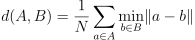
is the directed Hausdorff distance and
 and
and  are the set of non-zero pixels in the images.
- Parameters:
metric (str) – The identification string of the metric.
- class pymia.evaluation.metric.categorical.CohenKappaCoefficient(metric: str = 'KAPPA')[source]
Bases:
ConfusionMatrixMetricRepresents a Cohen’s kappa coefficient metric.
- Parameters:
metric (str) – The identification string of the metric.
- class pymia.evaluation.metric.categorical.DiceCoefficient(metric: str = 'DICE')[source]
Bases:
ConfusionMatrixMetricRepresents a Dice coefficient metric with empty target handling, defined as:
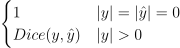
where
 is the prediction and
  the target.
- Parameters:
metric (str) – The identification string of the metric.
- class pymia.evaluation.metric.categorical.FMeasure(beta: float = 1.0, metric: str = 'FMEASR')[source]
Bases:
ConfusionMatrixMetricRepresents a F-measure metric.
- Parameters:
beta (float) – The beta to trade-off precision and recall. Use 0.5 or 2 to calculate the F0.5 and F2 measure, respectively.
metric (str) – The identification string of the metric.
- class pymia.evaluation.metric.categorical.Fallout(metric: str = 'FALLOUT')[source]
Bases:
ConfusionMatrixMetricRepresents a fallout (false positive rate) metric.
- Parameters:
metric (str) – The identification string of the metric.
- class pymia.evaluation.metric.categorical.FalseNegative(metric: str = 'FN')[source]
Bases:
ConfusionMatrixMetricRepresents a false negative metric.
- Parameters:
metric (str) – The identification string of the metric.
- class pymia.evaluation.metric.categorical.FalseNegativeRate(metric: str = 'FNR')[source]
Bases:
ConfusionMatrixMetricRepresents a false negative rate metric.
- Parameters:
metric (str) – The identification string of the metric.
- class pymia.evaluation.metric.categorical.FalsePositive(metric: str = 'FP')[source]
Bases:
ConfusionMatrixMetricRepresents a false positive metric.
- Parameters:
metric (str) – The identification string of the metric.
- class pymia.evaluation.metric.categorical.GlobalConsistencyError(metric: str = 'GCOERR')[source]
Bases:
ConfusionMatrixMetricRepresents a global consistency error metric.
Implementation based on Martin 2001. todo(fabianbalsiger): add entire reference
- Parameters:
metric (str) – The identification string of the metric.
- class pymia.evaluation.metric.categorical.HausdorffDistance(percentile: float = 100.0, metric: str = 'HDRFDST')[source]
Bases:
DistanceMetricRepresents a Hausdorff distance metric.
Calculates the distance between the set of non-zero pixels of two images using the following equation:

where

is the directed Hausdorff distance and
and are the set of non-zero pixels in the images.- Parameters:
percentile (float) – The percentile (0, 100] to compute, i.e. 100 computes the Hausdorff distance and 95 computes the 95th Hausdorff distance.
metric (str) – The identification string of the metric.
See also
Nikolov, S., Blackwell, S., Mendes, R., De Fauw, J., Meyer, C., Hughes, C., … Ronneberger, O. (2018). Deep learning to achieve clinically applicable segmentation of head and neck anatomy for radiotherapy. http://arxiv.org/abs/1809.04430
- class pymia.evaluation.metric.categorical.InterclassCorrelation(metric: str = 'ICCORR')[source]
Bases:
NumpyArrayMetricRepresents an interclass correlation metric.
- Parameters:
metric (str) – The identification string of the metric.
- class pymia.evaluation.metric.categorical.JaccardCoefficient(metric: str = 'JACRD')[source]
Bases:
ConfusionMatrixMetricRepresents a Jaccard coefficient metric.
- Parameters:
metric (str) – The identification string of the metric.
- class pymia.evaluation.metric.categorical.MahalanobisDistance(metric: str = 'MAHLNBS')[source]
Bases:
NumpyArrayMetricRepresents a Mahalanobis distance metric.
- Parameters:
metric (str) – The identification string of the metric.
- class pymia.evaluation.metric.categorical.MutualInformation(metric: str = 'MUTINF')[source]
Bases:
ConfusionMatrixMetricRepresents a mutual information metric.
- Parameters:
metric (str) – The identification string of the metric.
- class pymia.evaluation.metric.categorical.Precision(metric: str = 'PRCISON')[source]
Bases:
ConfusionMatrixMetricRepresents a precision metric.
- Parameters:
metric (str) – The identification string of the metric.
- class pymia.evaluation.metric.categorical.PredictionArea(slice_number: int = -1, metric: str = 'PREDAREA')[source]
Bases:
AreaMetricRepresents a prediction area metric.
- Parameters:
slice_number (int) – The slice number to calculate the area. Defaults to -1, which will calculate the area on the intermediate slice.
metric (str) – The identification string of the metric.
- class pymia.evaluation.metric.categorical.PredictionVolume(metric: str = 'PREDVOL')[source]
Bases:
VolumeMetricRepresents a prediction volume metric.
- Parameters:
metric (str) – The identification string of the metric.
- class pymia.evaluation.metric.categorical.ProbabilisticDistance(metric: str = 'PROBDST')[source]
Bases:
NumpyArrayMetricRepresents a probabilistic distance metric.
- Parameters:
metric (str) – The identification string of the metric.
- class pymia.evaluation.metric.categorical.RandIndex(metric: str = 'RNDIND')[source]
Bases:
ConfusionMatrixMetricRepresents a rand index metric.
- Parameters:
metric (str) – The identification string of the metric.
- class pymia.evaluation.metric.categorical.ReferenceArea(slice_number: int = -1, metric: str = 'REFAREA')[source]
Bases:
AreaMetricRepresents a reference area metric.
- Parameters:
slice_number (int) – The slice number to calculate the area. Defaults to -1, which will calculate the area on the intermediate slice.
metric (str) – The identification string of the metric.
- class pymia.evaluation.metric.categorical.ReferenceVolume(metric: str = 'REFVOL')[source]
Bases:
VolumeMetricRepresents a reference volume metric.
- Parameters:
metric (str) – The identification string of the metric.
- class pymia.evaluation.metric.categorical.Sensitivity(metric: str = 'SNSVTY')[source]
Bases:
ConfusionMatrixMetricRepresents a sensitivity (true positive rate or recall) metric.
- Parameters:
metric (str) – The identification string of the metric.
- class pymia.evaluation.metric.categorical.Specificity(metric: str = 'SPCFTY')[source]
Bases:
ConfusionMatrixMetricRepresents a specificity metric.
- Parameters:
metric (str) – The identification string of the metric.
- class pymia.evaluation.metric.categorical.SurfaceDiceOverlap(tolerance: float = 1, metric: str = 'SURFDICE')[source]
Bases:
DistanceMetricRepresents a surface Dice coefficient overlap metric.
- Parameters:
tolerance (float) – The tolerance of the surface distance in mm.
metric (str) – The identification string of the metric.
See also
Nikolov, S., Blackwell, S., Mendes, R., De Fauw, J., Meyer, C., Hughes, C., … Ronneberger, O. (2018). Deep learning to achieve clinically applicable segmentation of head and neck anatomy for radiotherapy. http://arxiv.org/abs/1809.04430
- class pymia.evaluation.metric.categorical.SurfaceOverlap(tolerance: float = 1.0, prediction_to_reference: bool = True, metric: str = 'SURFOVLP')[source]
Bases:
DistanceMetricRepresents a surface overlap metric.
Computes the overlap of the reference surface with the predicted surface and vice versa allowing a specified tolerance (maximum surface-to-surface distance that is regarded as overlapping). The overlapping fraction is computed by correctly taking the area of each surface element into account.
- Parameters:
tolerance (float) – The tolerance of the surface distance in mm.
prediction_to_reference (bool) – Computes the prediction to reference if True, otherwise the reference to prediction.
metric (str) – The identification string of the metric.
See also
Nikolov, S., Blackwell, S., Mendes, R., De Fauw, J., Meyer, C., Hughes, C., … Ronneberger, O. (2018). Deep learning to achieve clinically applicable segmentation of head and neck anatomy for radiotherapy. http://arxiv.org/abs/1809.04430
- class pymia.evaluation.metric.categorical.TrueNegative(metric: str = 'TN')[source]
Bases:
ConfusionMatrixMetricRepresents a true negative metric.
- Parameters:
metric (str) – The identification string of the metric.
- class pymia.evaluation.metric.categorical.TruePositive(metric: str = 'TP')[source]
Bases:
ConfusionMatrixMetricRepresents a true positive metric.
- Parameters:
metric (str) – The identification string of the metric.
- class pymia.evaluation.metric.categorical.VariationOfInformation(metric: str = 'VARINFO')[source]
Bases:
ConfusionMatrixMetricRepresents a variation of information metric.
- Parameters:
metric (str) – The identification string of the metric.
- class pymia.evaluation.metric.categorical.VolumeMetric(metric: str = 'VOL')[source]
Bases:
SpacingMetric,ABCRepresents a volume metric base class.
- Parameters:
metric (str) – The identification string of the metric.
- class pymia.evaluation.metric.categorical.VolumeSimilarity(metric: str = 'VOLSMTY')[source]
Bases:
ConfusionMatrixMetricRepresents a volume similarity metric.
- Parameters:
metric (str) – The identification string of the metric.
Continuous metrics (pymia.evaluation.metric.continuous) module
The continuous module provides metrics to measure image reconstruction and regression performance.
- class pymia.evaluation.metric.continuous.CoefficientOfDetermination(metric: str = 'R2')[source]
Bases:
NumpyArrayMetricRepresents a coefficient of determination (R^2) error metric.
- Parameters:
metric (str) – The identification string of the metric.
- class pymia.evaluation.metric.continuous.MeanAbsoluteError(metric: str = 'MAE')[source]
Bases:
NumpyArrayMetricRepresents a mean absolute error metric.
- Parameters:
metric (str) – The identification string of the metric.
- class pymia.evaluation.metric.continuous.MeanSquaredError(metric: str = 'MSE')[source]
Bases:
NumpyArrayMetricRepresents a mean squared error metric.
- Parameters:
metric (str) – The identification string of the metric.
- class pymia.evaluation.metric.continuous.NormalizedRootMeanSquaredError(metric: str = 'NRMSE')[source]
Bases:
NumpyArrayMetricRepresents a normalized root mean squared error metric.
- Parameters:
metric (str) – The identification string of the metric.
- class pymia.evaluation.metric.continuous.PeakSignalToNoiseRatio(metric: str = 'PSNR')[source]
Bases:
NumpyArrayMetricRepresents a peak signal to noise ratio metric.
- Parameters:
metric (str) – The identification string of the metric.
- class pymia.evaluation.metric.continuous.RootMeanSquaredError(metric: str = 'RMSE')[source]
Bases:
NumpyArrayMetricRepresents a root mean squared error metric.
- Parameters:
metric (str) – The identification string of the metric.
- class pymia.evaluation.metric.continuous.StructuralSimilarityIndexMeasure(metric: str = 'SSIM')[source]
Bases:
NumpyArrayMetricRepresents a structural similarity index measure metric.
- Parameters:
metric (str) – The identification string of the metric.